Everyone’s talking about AI in HR. But is your HR tech foundation actually ready for it?
At HR Tech Fest recently, our Managing Director Craig Aunger joined Emily Connell, Senior Director of Services at ELMO Software, on stage for Connected HR: The Foundation for a Connected Workforce.
It was a candid, practical chat about what it really takes to move from disconnected systems to a connected platform. And why that foundation matters more than ever in the age of AI.
The message was clear. AI is not a shortcut around the fundamentals of HR technology. If your systems are disconnected, your data is patchy and you’re not sure what you’re trying to achieve, AI isn’t going to be a magical silver bullet. It’s the reward for getting the foundations right.
Craig shared seven (7) lessons for every HR leader who is either:
- Evaluating a new HR tech platform and need a business case that sticks
- Embarking on a major HR tech transformation (or you’re already knee-deep in one)
- Evolving an existing HR tech ecosystem, with AI firmly on your strategic roadmap.
ELMO has also published a great recap of the session, Why connected HR is the foundation for a connected workforce, covering what “connected” really means, a data readiness checklist and the roles your team needs. Read it alongside this one.
Here, we focus on Craig’s hard-learnt lessons from 25+ years and over 1,000 HR tech projects.
1. Start with the Why (Then Ask It Again. And Again.)
Over the past decade, we’ve watched the HR tech market shift steadily from point solutions for recruitment, learning, performance, payroll and WFM to connected people platforms. Today, most organisations want fewer vendors supporting the employee lifecycle.
But “we want fewer systems” isn’t a compelling business case. Neither is “we want to reduce admin”. Those benefits are real, but they won’t win you a platform-sized budget. And they certainly won’t keep your executives in your corner when things get bumpy.
So how do you get to core of what the business really needs? Keep asking why.
“You’ve got to keep asking the question why. Keep asking the business what they’re doing that is mission critical, that you can then support with this initiative.” – Craig Aunger, Managing Director, Pinpoint HRM
Here’s what that sounds like in practice:
- Why are we doing this? To reduce integrations and admin.
- Why does that matter? To improve the employee experience.
- Why does that matter? Because employee experience drives customer experience.
- Why does that matter? Because great customer experience drives sales and repeat customers.
And just like that, you’re speaking your executive team’s language.
The business objectives we hear vary wildly from client to client. Yet they almost always boil down to the same three enabling capabilities:
- Analytics in the flow of work, so leaders make better people decisions with timely information
- A better employee experience. Not just a slick, consumer-grade app, but employees who feel genuinely valued because your people processes and practices are more contemporary
- A more strategic HR function, freed up to deliver higher value-added services to the business.
And guess what? AI supercharges all three! If you’re clear on your why now, it becomes the backbone of your HR AI business case later.
2. Know Where You’re Heading: HR-AI Maturity Model
AI is on every HR leader’s agenda. So, not surprisingly, our clients are asking: what should our roadmap for workforce AI actually look like?
That’s how the Pinpoint HR-AI Maturity Model was born. Five levels that map how organisations grow from dabbling with AI to dramatically transforming what the business can do.
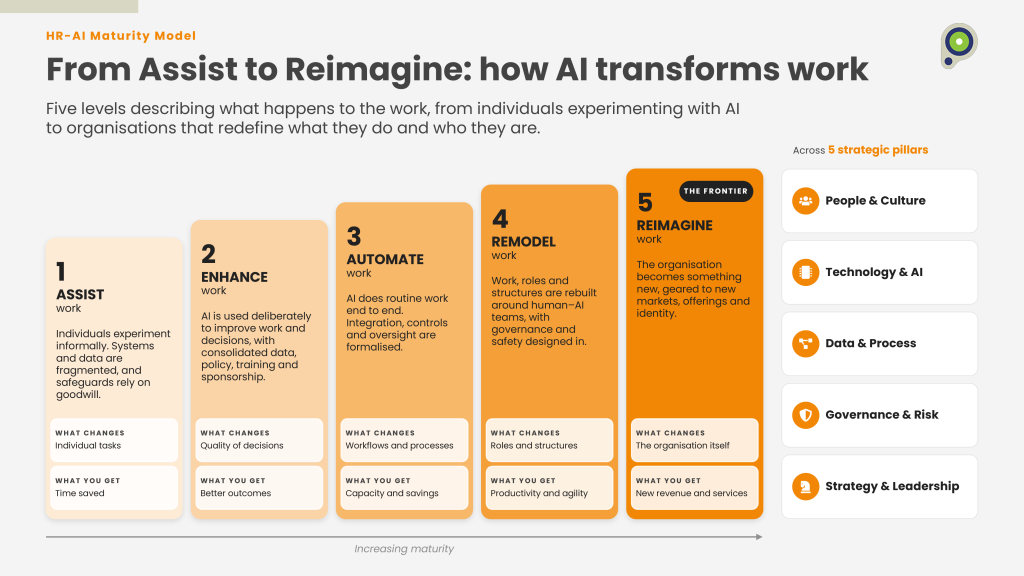
So where does your organisation sit today? And where do you want it to be in 3-5 years?
Here’s our view. HR platforms are the context layer for workforce AI. They hold your org structure and hierarchy, access and permissions, and skills and performance data. And in a connected platform, everyone in the organisation uses it, securely.
“If you think about it, there’s no other platform, whether it’s ERP or supply chain or finance, that holds all that really important people data,” says Craig.
That context is what lets AI serve up information that’s relevant, approved and within your organisation’s guardrails. As Craig put it, using AI with a secure integrated workforce platform, means “it knows that person’s role, it knows what they should have access to, what they shouldn’t.”
Fragmented systems and patchy data break that chain. Which means the platform decisions you make today quietly set the ceiling on how far up the HR-AI maturity model you can climb tomorrow.
Key takeaway: Choose and build your platform with future maturity in mind, not just getting to go-live. Want to see a maturity model in action? Hear how ECMS applied the Pinpoint maturity model to evaluate and select their people solutions.
3. The Number One Risk Is on Your Side of the Project
Craig breaks every HR tech project into the before, the during and the after. The before is the stage that’s most often underdone. And it’s exactly where the biggest risk hides.
Craig provides the insight: “The number one risk in these projects is not who the vendor is, or who’s going to do the implementation. It’s the customer side of the equation. It’s how well-resourced your team is to do this project.”
This is where a strong ‘why’ pays for itself. When your project is tied to business outcomes, it’s far easier to secure budget for the right people with dedicated time to the project, and an executive sponsor who’ll go in to bat for them.
The classic trap? Assuming your team can run an HR tech project on top of their day jobs. As Emily put it at HR Tech Fest, “this isn’t a BAU activity.” You simply can’t run a strategic workforce software implementation on spare capacity.
ELMO’s article lists the five roles every implementation needs, and our Meet your Dream Team: 8 roles that define Cloud HR project success goes deeper on each one.
4. Never Underinvest in Change
If there’s one line from the session that deserves pride of place on every project room wall, it’s this one from Craig, “I’ve never seen change overdone. I’ve seen it underdone a lot.”
Pinpoint’s rule of thumb is that investment in change management should be around 20% of your total implementation budget. On a full platform project, that’s a big number. Which is exactly why it’s so often the first line an executive team crosses out. “The managers can handle that. Everyone’s sick of the old tech anyway. They’ll be excited!”
They might well be excited. There will still be pushback.
Craig shared a line he’d heard earlier that morning that sums it up well. Change isn’t really about the change itself. It’s about the grief of losing what people were comfortable with.
That’s why change starts on day one, not a month before go-live. Get the right people on the bus early, and plan for the emotional side of change as deliberately as the technical side. For more, read 7 Myths About Change Management in HR Tech Projects Exposed!
5. Data Is the Killer (and Decisions Can’t Wait)
Once the project’s underway, two things will test you. Your data, and your ability to make decisions. Craig warns, “Data is the killer. Particularly on a platform.”
Bring payroll, WFM, learning, performance and recruitment together, and it gets tricky. Duplication, gaps, discrepancies, dependencies. Guaranteed. Data work isn’t a one-off migration task at the start. It runs through every stage of the implementation, and it matters most during testing. (If testing gives you nightmares, you’ll love 10 Things I Hate About U-AT.)
But the answer is not to wait until every data issue has been resolved. That approach will only delay progress. Instead, establish a clear data readiness plan that establishes where the data is coming from, who owns it and who is accountable for its quality.
Then there are the critical decisions that need to be made. Craig calls it building the plane as you fly it.
“It doesn’t matter how well-planned you are, or how much work you do re-engineering a process before you start the project. There are decisions you’re going to need to make reasonably on the fly throughout the project.”
If every one of those decisions has to go back to committee, your project slows to a crawl. And slow projects are costly. So give the right people the authority to make pragmatic, speedy decisions. And remember, sometimes the smartest decision is to park it and come back after go-live.
6. Go-Live Is the Starting Line, Not the Finish Line
Think about what’s waiting on the other side of go-live. The items you parked during implementation. New vendor releases every three to four months. A business that never stops evolving. The rapid pace of AI development. And a steady stream of “can we have this?” requests from users. Without a coordinated approach, well-meaning individuals start changing the system on their own.
“Everyone gets to go-live and goes, ‘Phew, we’re done.’ But that shouldn’t be the end. It should be the start of the next stage of the project,” suggests Craig.
That’s why Pinpoint recommends treating your solution as a project for at least the first two years after go-live. You won’t need the full team, but keep a core crew on to:
- finish the unfinished elements of the project
- establish an effective HR tech operating model
- drive high levels of adoption
- collect, prioritise and deliver continuous improvement opportunities
- stay on top of new releases, including the AI capabilities they bring.
For the ‘Evolvers’ reading this, this is where your climb up the HR-AI Maturity Model really begins.
7. Protect Your Project Through the Bumps
Craig closed with an analogy even the MC admitted he hadn’t heard before.
“Treat the project like it’s an infant. Care for it, foster it, develop it. Your infants drive you crazy sometimes, but they’re incredibly rewarding once they come out of that stage.”
Things will go wrong. It doesn’t matter how well you plan. What matters is how your organisation responds when they do. The real danger is when a few bumps turn into a story that everyone latches onto: this project is failing. Once that mindset takes hold, it’s hard to turn it around.
So prepare your steering committee early. Tell them things will go awry and agree up front how you’ll handle it as a team. Then, when the twists and turn come (and they will), stay calm, pragmatic, protect the project and power on.
Where to Start: Your Next Move
Craig’s three essentials apply to everyone. Get crystal clear on your why, in business language. Be realistic about the budget, timeline and resources it will take. And put strong governance in place. Here’s how to put them to work, wherever you are on the journey.
If you’re evaluating a new HR tech platform
- Be clear on the ‘why’ with your executive team before you look at a single demo
- Tie your business case to analytics, employee experience and agility, not just admin savings
- Assess vendors on how they can elevate your HR-AI maturity, not just what they do today
- Budget realistically for client-side resources, and around 20% for change, from the start
If you’re embarking on an HR tech transformation
- Name your project team and protect their time. Your side of the project is the biggest risk
- Set up governance to make pragmatic decisions fast, including what to park until after go-live
- Treat data readiness as a workstream that runs from before, during and after the project
- Prepare your executive or steering committee for bumps before they happen
If you’re evolving an existing HR tech ecosystem
- Work out where you sit on the HR-AI Maturity Model today, and where you want to be
- Articulate your future state against business drivers, then map out the options to get there
- Define an operating model that keeps your ecosystem evolving, with clear AI governance
- Tackle the data and access foundations that will unlock HR-AI maturity Levels 3 to 5
Wrapping It Up
The organisations that get the most from workforce AI won’t necessarily be the ones buying the newest tool. They’ll be the ones that understood their why, resourced their team properly, invested in change, got their data in shape and kept evolving their platform long after go-live.
And to end with the wise words of Pinpoint’s Managing Director, Craig Aunger: “The climb up the HR maturity ladder doesn’t start with AI. It starts with your why.”