


Today HR technology solutions are crucial in driving better business outcomes, enhancing employee experience and facilitating growth. Yet getting Cloud HR investments to deliver on these expectations, months and even years after go-live, is a challenge organisations truly grapple with.
While going live with a new system might fill us with excitement and relief, what lies beyond may not. You may recognise these sentiments shared by HR leaders after go-live:
- Our employees haven’t fully embraced the new HR system
- User support queries are swamping our team
- We’re falling behind on new releases from our vendor
- We’re resource-strapped and our budget is limited
- We can’t see the benefits promised in our business case
Clearly, many organisations are experiencing these issues first-hand! According to recent research by Gartner*, ensuring ongoing adoption of HR technology solutions, justifying technology investments, and developing a strategic roadmap for HR transformation are the top three hurdles facing HR technology leaders in 2023.
This research and the comments above emphasise that the ‘go-live’ moment is merely the start of the journey and highlight how important it is to plan and prepare for the next phase of your transformation.
This article explores the significance of post go-live activities in maximising the value of your investment in HR tech projects and how to thrive beyond go-live!
Planning for the long game
The HR transformation lifecycle can span three to five years, involving vendor selection, preparation, solution delivery and ongoing optimisation. While the technology implementation is a significant part of this, true success lies in what happens after go-live.
 Diagram: The 5 stages of HR Tech Projects
Equal focus should be given to ensuring that your new HR technology platform is not treated as a “set and forget” solution but nurtured and optimised to evolve alongside your changing business needs.
Recognising that your project extends beyond the go-live moment and treating it with a structured, well-managed, well-resourced and funded ‘project-based’ approach will ensure your long-term success.
The First Year After Go-Live: The Transition Phase
The 6–12 month period following your initial go-live (we refer to it as the ‘Transition Phase’) is arguably the most critical time in your HR transformation program. It’s when your project gradually moves into Business-As-Usual (BAU) reality.
Your workforce is learning and adapting to a new system, practices and processes. The effectiveness of your change management approach is tested in this phase, with adoption and acceptance as key success indicators. Planning for this phase before going live is vital to navigating common risks.
It’s a period where a few bumps and potholes can unravel all the incredible work put into planning, designing, and implementing your exciting new platform.
During this phase, you are laying the foundations of your HR Tech operating model to enable more strategic optimisation and benefits realisation in the coming months and years. Without these fundamentals in place, you may not reach the elevated benefits you set out to achieve.
Pinpoint’s methodology addresses these five essential elements as critical success factors during Transition:
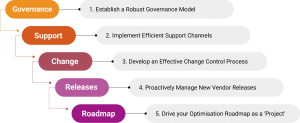
Within each of these, a series of activities, controls, processes, and tools need to be in place to support and govern the operations of your HR tech landscape [stay tuned for more on this in our next article!]
Trouble in Transition: When HR Tech Foundations Falter
Failure to cement one or more of these building blocks during Transition can expose you to a range of risks that could hold you back from full benefits realisation, such as:
- Lower user adoption rates due to ineffective change management or training
- Confusion and a lack of accountability due to unclear roles and responsibilities
- Misplaced or poorly managed requests caused by an unstructured support process
- Misalignment with business priorities in the absence of a formal feedback process
- No process to evaluate and adopt enhancements from new vendor releases
- Limited resources and funding for BAU operations and optimisation
- No documented HR Tech Strategy & Roadmap to drive business outcomes
With over 850 HR tech projects delivered to more than 300 HR leaders in the past two decades, we at Pinpoint understand these challenges intimately. We know that this transition phase, when you’re shifting capability from the project into BAU mode, is the critical period that can often determine the long-term success or failure of your project and investment.
So what’s really at stake if you don’t get this right? Well, it’s not just the credibility of your project or HR team—it’s the confidence of your entire business. Missteps in this early stage can erode trust in the new system and processes, creating unnecessary headaches for everyone. Smoothly navigating this phase can position you as the superstar behind Cloud HR. But stumble so soon, and you risk hearing nothing but “aaargh”!
Beyond Transition: Optimisation and Transformation
If you’ve managed the Transition Phase well, organisations typically move into a more predictable and sustainable rhythm. What we refer to as the ‘Optimisation & Transformation’ phase. While it’s easy to become complacent in your newfound stability, this is a pivotal time to reinforce focus on your end goal.
During this time, it’s common for some key SMEs who have been champions of your project and transition phase to move onto new challenges. It’s crucial to have robust, relevant documentation and succession plans to transfer knowledge seamlessly to new system administrators and key contributors.
And there’s still work to be done in fostering a more mature HR tech ecosystem: delving deeper into the realm of analytics, leveraging the power of AI, building advanced integrations, enhancing optimisation, and integrating ‘Plus 1’ applications. Now is the time to step up and champion true business transformation.
As you progress in these years beyond go-live, it’s essential to regularly assess how your existing processes might need to evolve to keep up with best practices. Staying current with the latest trends in HR tech to further build upon your existing foundations will bring sophistication to your operations and HR tech landscape. Advanced analytics will be your compass, guiding your business towards deeper insights and enabling more informed decision-making and workforce planning.
The key to your long-term success is finding opportunities to enhance the employee experience further and creating a fully optimised HR tech ecosystem that meets and exceeds your evolving workforce’s expectations.
Remember, this is a dynamic, evolving environment. It needs ongoing nurturing and attention to continue to deliver on the expectations of your executives, managers, HR team, and, most importantly, your employees. As you continue on this journey, your investment in HR tech will grow and evolve, driving impactful results and transforming your business for the better.
HR Tech Maturity Milestones: Signs of Success Post Go-Live
When your HR tech operations are humming in BAU, it doesn’t just show – it shines. Here’s what your success looks like:
- An Empowered Workforce: Your employees aren’t just using your HR technology solutions – they’re thriving with them. They’re integrating these tools seamlessly into their daily flow of work, boosting productivity and enhancing effectiveness
- Data-Driven Leadership: Trust is the backbone of effective leadership, and your leaders trust the data integrity of your HR systems. They’re leveraging real-time analytics, insights, and reports, turning data into informed decisions.
- Focused People Leaders: Your people and culture leaders aren’t bogged down by day-to-day admin. Instead, they’re laser-focused on strategic initiatives and transformation, driving your organisation forward.
- Engaged Employees: Your HR tech ecosystem isn’t just functional – it’s delightful. Employees enjoy interacting with it, and their high engagement fuels regular, proactive feedback.
- Cultivating Innovation: You’re not waiting for feedback – you’re actively seeking it. By prioritising and aligning this feedback with your strategic objectives and vendor enhancements, you’re continually refining your HR tech ecosystem. You’re not just maintaining sophistication – you’re constantly elevating it.
Next Steps: If You’re in Transition or about to Go-Live
If you plan to go live soon, start preparing for the transition phase now. Workshops with relevant stakeholders will help determine what is involved, governance models, roles and responsibilities, resources, and budget. Pinpoint are on hand to support and guide you through this process if you need it, with a ready-to-go methodology and toolkit.
If you’re already live, a Post Go-live operational maturity assessment or review will help identify current challenges and gaps that need addressing. Pinpoint has developed a suite of tools to assist with this review, including a 20 minute Self-Assessment that will give you a snapshot of how your BAU operating model compares to good practice. We also utilise insights tools that can track digital adoption and identify areas of struggle for system users.
As The HR Tech Project Experts, Pinpoint can provide tools and guidance to help you navigate these stages or work with you directly to address these challenges. Because in the HR Tech journey, we know ‘go-live’ is really ‘go-begin’.
Need help with your HR tech project or looking to get more from your current solution? Contact our HR tech experts today.
Stay tuned for our next article that will go into each element of the Transition Phase in more detail and provide practical guidance on what’s involved in getting this critical time after post go-live right!
*Research References:
Gartner for HR: HR Technology Planning Imperatives for 2023 and Beyond